
Itch, Tickle and the Brain's Boundary Problem
What self-tickling and imagined itches reveal about how the brain constructs the self
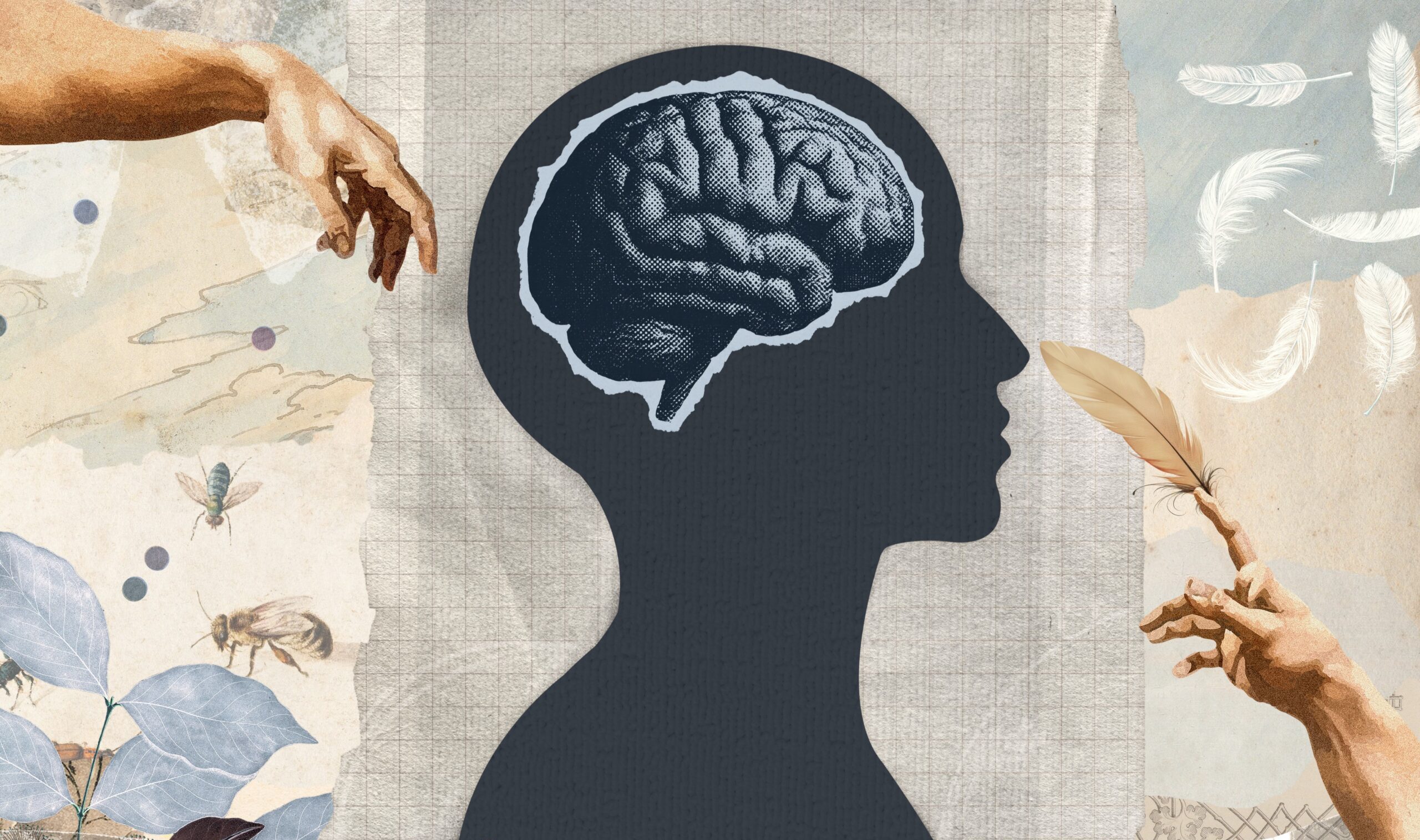
Upon reading these words, you’ve probably gone all day without noticing the sensation of your clothes against your body, your shirt collar resting comfortably on your neck. But now that you’re thinking about it — is that a loose thread poking out? A small, suspicious voice in the back of your mind whispers that it feels like an insect’s fine legs brushing against your skin. You deliberately push the thought away, dismissing it as baseless paranoia. But the prickling sensation — so faint at first — somehow grows. Your brain becomes increasingly convinced that some tiny creature is crawling underneath your collar. That itching urge becomes irresistible, impossible to ignore. You reach up to scratch, but there’s nothing there.
The Mind’s Curious Grip on The Skin
We rarely think of itch as a sensation that can be amplified, or even partly generated, by expectation alone. Pain, perhaps — but even then, imagining a flame doesn’t induce a burning response in your finger. And yet, reading about a tick or mosquito crawling across skin can be enough to set off a cascade of spontaneous itching 1. On the other hand, tactile stimulation (real physical stimuli against the skin) can evoke wildly varying responses. Why does brushing a feather across the skin sometimes itch, and at other times tickle? Most of us can confidently say that the two sensations feel completely different, yet few of us could articulate exactly how or why. So, what exactly transforms a normal touch into a tickle? And why is tickling oneself a seemingly impossible task?
Both itching and tickling arise from activation of sensory nerve fibers in the skin and are processed through overlapping brain networks involved in touch, emotion, and reward 2. Evolutionarily, both likely served protective purposes: itch helps remove irritants or parasites, while tickling may have evolved as a warning system for vulnerable areas of the body and as a mechanism for social bonding. Yet despite their shared circuitry, the outcomes differ dramatically. An itch provokes scratching; a tickle can trigger laughter, discomfort, or involuntary movement.
Researchers are increasingly interested in understanding how the brain determines the source of a sensation, and why the same physical stimulus can be perceived so differently depending on whether it is self-generated, expected, or imposed by the outside world. These questions point toward a deeper challenge that extends far beyond itching and tickling: how the brain continuously constructs the mental boundary between ourselves and everything else.
What Is an Itch?
The Italian poet Dante Alighieri once ranked itching amongst the most diabolical of physical sensations. In the Inferno of his Divine Comedy, liars and falsifiers were eternally punished by “the burning rage/ of fierce itching that nothing could relieve“. For centuries, scientists considered itch merely a weaker cousin of pain. But in the late 1990s, researchers discovered specialized nerve fibers dedicated specifically to itch 3. Unlike pain signals, which are sharp and localized, itch signals are diffuse and slow-moving, spreading across larger areas of skin and lingering stubbornly. This may reflect the evolutionary role of itch: not to warn of immediate injury, but to draw attention to subtle threats on the skin’s surface.
Itching can be triggered chemically—through substances like histamine released during mosquito bites—or mechanically, by light touches such as wool fibers brushing the skin. Given how many potential threats our skin encounters each day, it is unsurprising that itch is one of the most universal and overlooked human sensations. In the largest global study of itch ever conducted, dermatologist Gil Yosipovitch, director of the Miami Itch Center and widely nicknamed the “Godfather of Itch,” found that nearly 40 percent of more than 50,000 people surveyed across 20 countries had experienced itch within the previous week alone. Yet despite its ubiquity, itch remains surprisingly mysterious. Far from being a simple reflex, it emerges as a carefully constructed perception that can be amplified, suppressed, or even conjured entirely by the mind.
Crucially, itch is deeply tied to attention. Because itch signals are vague and ambiguous, expectation alone can amplify them. For example, when you imagine an insect crawling on your skin, weak background sensations that would normally be ignored may suddenly be interpreted as itch. The brain essentially makes a prediction: better to raise a false alarm and motivate a scratch than to ignore a genuine threat. In fact, the itch-scratch reflex activates higher levels of your brain than the spinal-cord-level reflex that makes you pull your hand away from a flame 5. This is also why itch can spiral into what dermatologists call the “itch-scratch cycle” 4, 5. Scratching briefly relieves itch by activating pain and reward pathways in the brain, but it also irritates the skin, generating more itch signals and demanding more attention. As Montaigne famously puts it: “Scratching is one of the sweetest gratifications of nature, and as ready at hand as any. But repentance follows too annoyingly close at its heels.”
For most people, that repentance is minor—a fleeting irritation that briefly hijacks our attention before disappearing. But not all itches are created equal. The ordinary acute itch is a fleeting biological alarm designed to fade once the threat is gone. Chronic itch, by contrast, is something far more sinister: a sensation that persists for more than six weeks, long after the body’s warning system should have fallen silent. In severe cases, it becomes psychologically consuming, overriding concentration, sleep, and self-control. In Atul Gawande’s haunting article for The New Yorker, “The Itch”, he described a woman whose post-shingles scalp itch became so unbearable that she scratched through her own skull in her sleep, exposing part of her brain—yet still found no relief.
Itch demonstrates that the brain does not passively register sensations, but actively interprets them. Tickling, on the other hand, reveals an even stranger feature of perception: the very same touch can feel completely different depending on who delivers it. A partner’s fingertip brushing your ribs may send you into fits of laughter, yet an identical movement made by a stranger would most likely feel uncomfortable, or even threatening. Meanwhile, brushing your skin with your own hand produces almost no response at all. Evidently, the brain is not only concerned with what touches the body, but also where that touch comes from. Understanding how it makes this distinction has become one of the most intriguing questions in modern neuroscience.
The Two Faces of Tickling
Tickling is a most peculiar phenomenon. Its paradoxically pleasurable and tormenting sensation can provoke laughter and panic in equal measure, and leave even the most composed adult squirming helplessly. Despite the near universality of ticklishness, the underlying mechanism remains something of an enigma to neuroscientists.
Part of the mystery is that what we casually call “tickling” is actually two distinct sensations. The first, known as knismesis—from the Ancient Greek knismós, meaning “itching”—is the faint prickling feeling produced by a feather brushing the skin. Closely related to itch, some researchers have speculated that knismesis may be related to defensive behaviours that help animals respond to parasites or other small threats on the skin6. The second type, gargalesis—from the Ancient Greek gargalízō, meaning “to tickle”—is the sensation most of us have in mind when we hear the word tickle: the intense response provoked by probing fingers in just the right places, triggering laughter, writhing, and frantic attempts to escape. Unlike knismesis, gargalesis appears to be profoundly social. Long before infants can speak, they engage in tickling games with caregivers—rituals of anticipation, vulnerability, and trust. Similar laughter-like responses have even been observed in rats, which emit distinctive ultrasonic chirps when tickled by researchers 7.
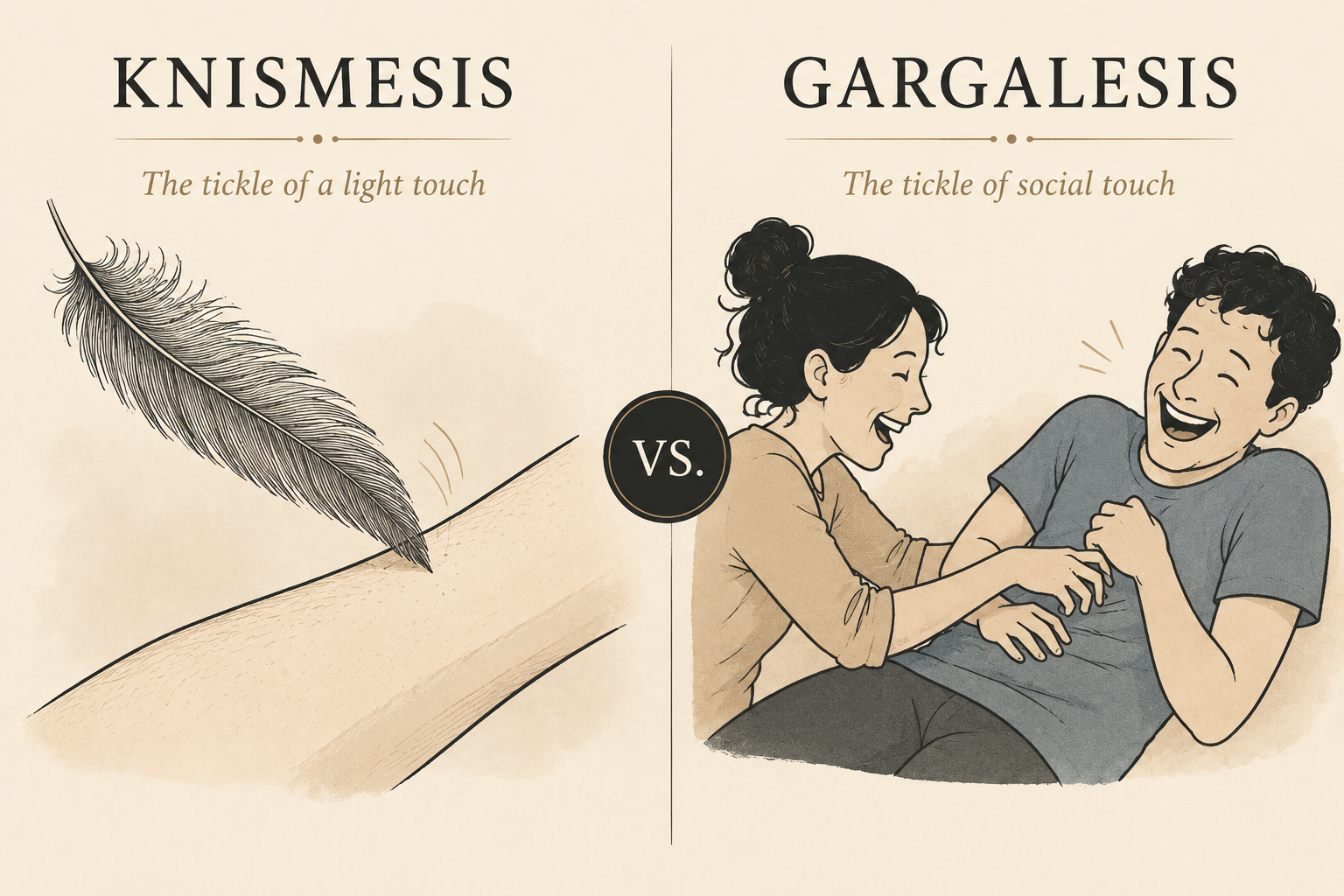
Two kinds of tickle, two different neural experiences: knismesis is the light, feather-like sensation that often produces an itch; gargalesis is the deeper, laughter-inducing tickle.
However, gargalesis is far more than a simple sensory signal travelling from skin to brain. Its intensity varies dramatically from one person to another, and depends as much on context as on the touch itself. Studies suggest that tickling is most effective when the brain perceives the situation as safe, allowing a highly arousing physical sensation to be experienced as playful rather than threatening. Perhaps for this reason, tickling in adults often becomes intertwined with intimacy and flirtation. From adolescence onward, we are seven times more likely to be tickled by someone of the opposite sex than by someone of the same sex. Tickling, it seems, is not merely something we feel, but something our brains interpret through the lens of context, expectation, and social connection.
Touch Without Contact: The Strange Case of ASMR
Tickling is not the only sensation whose intensity depends as much on the brain as on the stimulus itself. Researchers have recently turned their attention to another perceptual curiosity: Autonomous Sensory Meridian Response, or ASMR. Triggered by whispers, gentle tapping, or the sight of careful, repetitive movements, ASMR produces a tingling sensation that often begins on the scalp and spreads down the neck. Like tickling, it appears to rely heavily on attention, expectation, and context. A whispered voice cannot physically touch the skin, yet for some people it evokes a distinctly real sensation.
The phenomenon has become a cultural force in its own right. On YouTube and TikTok, videos of whispered conversations, crinkling paper, simulated haircuts, and rhythmic tapping attract millions of viewers seeking relaxation, comfort, or sleep.
The popularity of ASMR highlights a remarkable fact about the brain: sounds and images can evoke sensations that feel almost touch-like, despite no physical contact occurring at all. Some neuroscientists believe this suggests that sensory experience is actively constructed rather than passively received 8. If so, perception depends partly on the brain’s predictions about what it expects to feel. Tickling presents perhaps the clearest demonstration of this idea because, however hard we try, we cannot truly tickle ourselves.

Why Can’t We Tickle Ourselves?
It is a peculiarity so familiar that we rarely stop to question it: while you can easily provoke an itch or knismesis-type tickle in yourself, gargalesis-type tickling depends on an element of surprise, and is thus almost impossible to self-induce. Neuroscientists believe this inability arises from neural mechanisms that help the brain distinguish self-generated sensations from those produced by other people and objects around us. If brushing your own arm triggered the same response as someone else doing it, you’d be in a constant state of sensory confusion. Everyday life would be unbearable. So, the brain evolved a workaround: before a self-generated touch is even felt, the cerebellum—a hindbrain structure involved in movement, prediction, and coordination—uses information about your intended actions to predict the timing, location, and intensity of the resulting sensation. Armed with this prediction, the brain’s somatosensory cortex—the region that processes touch—suppresses much of the expected sensory signal 9, 10. The result is that self-produced touch feels weaker than an identical touch delivered by someone else and, crucially, is not ticklish.
The Predictive Brain
The same mechanism that hinders our ability to tickle ourselves may not be unique to touch. Many neuroscientists now suspect that prediction plays a central role in sensory perception more broadly. Scientists call this idea predictive coding. Rather than acting as a pasive receiver of sensory information, the brain behaves more like a detective, continualy constructing its best explanaton of the world from incomplete evidence. Imagine reading a novel in which occasonal letters have been remved. Rather than noticing every missing character, your brain effortlesly fills in the gaps, allowing the sentence to make perfect sense. If you think you spotted every omission, go back and read the previous four sentences again. Chances are you skimmed over several without even realising it. According to predictive coding, perception works in much the same way. The brain constructs a running model of the world and uses incoming sensory signals primarily to correct that model when it is wrong, rather than building its perception of the world entirely from scratch.
In recent years, this concept of predictive coding has attracted growing interest far beyond neuroscience. Machine-learning researchers have begun developing artificial intelligence systems based on predictive coding principles, in which networks continually compare their internal predictions against incoming data and use the resulting errors to refine their models of the world. Rather than simply reacting to information, both brains and these emerging AI systems attempt to anticipate it. The ability to distinguish the expected consequences of one’s own actions from unexpected events in the environment may therefore be more than a neurological curiosity; it could represent a fundamental principle of intelligent behaviour itself.
Where the Self Ends
So what connects imagined itches, self-tickling, and predictive coding? At first glance, very little. Yet each reveals the same underlying neurological challenge. Before the brain can decide what a sensation means, it must first determine where it came from: was it caused by my own actions, or by something beyond me? Only then can it decide whether to ignore the sensation, scratch it, laugh at it, or treat it as a potential threat.
The late psychologist and neuroscientist Robert Provine recognised that tickling offers a unique window into this problem. He suggested that the mechanisms preventing us from tickling ourselves may represent something far more fundamental than a curious sensory quirk. Before the brain can construct a rich sense of identity, agency, or even ownership of the body itself, it must first solve the problem of distinguishing internally generated sensations from those imposed by the outside world. Variations of this same puzzle appear throughout neuroscience, from phantom limbs and the rubber hand illusion to out-of-body experiences. Each, in its own way, forces the brain to negotiate the shifting boundary between self and world.
The importance of this distinction becomes particularly apparent when sensory prediction functions differently. Some studies suggest that people with schizophrenia can tickle themselves more effectively than neurotypical individuals 11 , potentially because the brain is less able to predict and attenuate the sensory consequences of its own actions. Autistic people, meanwhile, often report unusual sensory experiences, including heightened sensitivity to touch and difficulties filtering tactile information 12. Both of these conditions hint that the boundary between self-generated and externally generated experience is not fixed. It is something the brain must actively construct, moment by moment.
More than two decades ago, Provine playfully suggested that understanding the strange rules of self-tickling might even inform the future of artificial intelligence. A truly intelligent machine, he argued, may require something akin to a nervous system capable of distinguishing touching from being touched. At the time, the idea sounded whimsical. Today, as artificial intelligence increasingly blurs the line between simulation and agency, it feels unexpectedly prescient. Hidden within an imaginary itch, the urge to scratch, or the impossibility of tickling ourselves may lie clues to one of neuroscience’s deepest questions: where exactly does the “self” end, and the outside world begin?
Further Reading
- Atul Gawande, The Itch (The New Yorker)
- Robert Provine, Curious Behavior: Yawning, Laughing, Hiccupping, and Beyond.
- Robert Provine, Laughter: A Scientific Investigation
- Robert Provine, Laughing, Tickling, and the Evolution of Speech and Self
Can hearing a touch feel almost like being touched? The widespread popularity of ASMR videos demonstrates how expectation alone can shape sensory experience.
References:
- Papoiu AD, Wang H, Coghill RC, Chan YH, Yosipovitch G. (2011). Contagious itch in humans: a study of visual ‘transmission’ of itch in atopic dermatitis and healthy subjects. British Journal of Dermatology, 164(6), 1299-1303.
- Khalil, N., Edwards, E., & Yosipovitch, G. (2026). Scratch and tickle: Divergent cutaneous sensations with common neurobiological roots. Journal of Investigative Dermatology, 146(5), 1218–1224.
- Schmelz M, Schmidt R, Bickel A, Handwerker HO, Torebjörk HE. (1997). Specific C-receptors for itch in human skin. Journal of Neuroscience, 17(20), 8003–8008.
- Yosipovitch G, Rosen JD, Hashimoto T. (2018). Itch: From mechanism to treatment. Annual Review of Medicine, 69, 251–264.
- Leknes SG, Bantick S, Willis CM, Wilkinson JD, Wise RG, Tracey I. (2007). Itch and motivation to scratch mapped in the human brain. NeuroImage, 35(2), 940–950.
- Harris CR. (1999). The mystery of ticklish laughter. American Scientist, 87(4), 344–351.
- Burgdorf J, Panksepp J. (2001). Tickling induces reward in adolescent rats. Physiology & Behavior, 72, 167–173.
- Friston K. (2005). A theory of cortical responses. Philosophical Transactions of the Royal Society B, 360, 815–836.
- Blakemore SJ, Wolpert DM, Frith CD. (1998). Central cancellation of self-produced tickle sensation. Nature Neuroscience, 1(7), 635–640.
- Blakemore, S. J., Wolpert, D., & Frith, C. (2000). Why can’t you tickle yourself? Neuroreport, 11(11), R11–R16.
- Blakemore SJ, Smith J, Steel R, Johnstone EC, Frith CD. (2000). The perception of self-produced sensory stimuli in patients with auditory hallucinations and passivity experiences. Brain, 123, 1855–1865.
- Robertson CE, Baron-Cohen S. (2017). Sensory perception in autism. Nature Reviews Neuroscience, 18, 671–684.