
Why Did the Universe Evolve Intelligent Minds?
Everything in nature seems to drift towards disorder. So why did evolution produce minds capable of creating art, mathematics, and civilisation? A counterintuitive new theory suggests these two trends may be fundamentally connected.
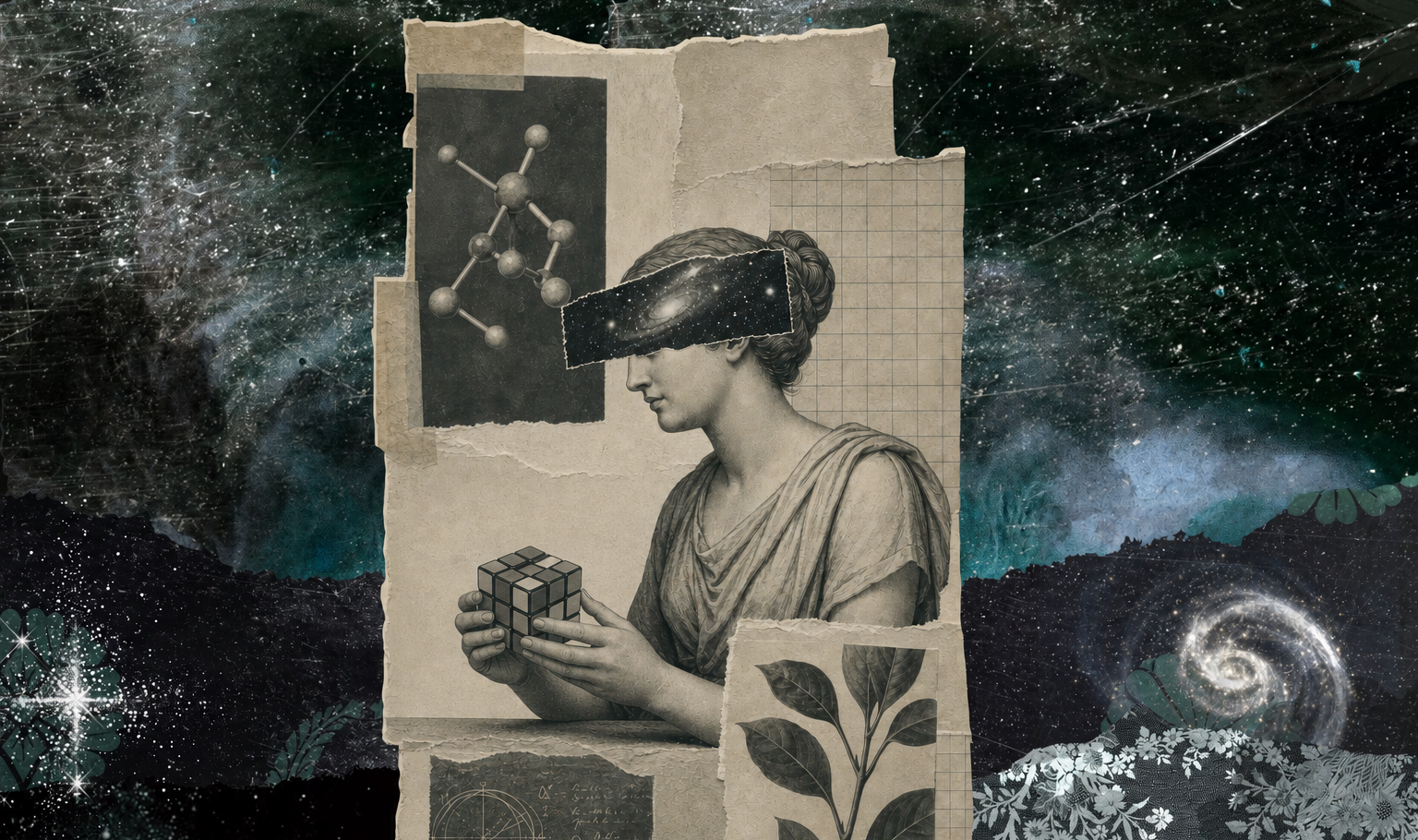
The Puzzle of Order in a Disordered Universe
It is on the humble stage of the breakfast table that we are daily reminded of one of nature’s deepest truths: the universe seems to have a strong tendency towards disorder. Pouring milk into our espresso, we watch the swirling eddies of white and brown rapidly blend into a uniform beige. A pat of butter’s crystalline architecture collapses on warm toast, abandoning its fatty form for a greasy sheen. The catastrophic fracture of an eggshell, cracked on the counter, announces a one-way transition from whole to fragmented. The gooey contents spill out and spread across the pan in a form notably distinct to yesterday’s. In this quiet performance, we glimpse a fundamental dissymmetry in nature: change proceeds effortlessly in one direction, but rarely retraces its steps. No matter how long we watch and wait, the coffee swirls don’t spontaneously reappear, the butter does not reassemble into its solid blob, the eggshell will never become whole again.
This apparent temporal asymmetry is formalised through the Second Law of Thermodynamics, which states that the entropy of a closed system always increases. But what, exactly, is entropy? Despite its universality, entropy is perhaps the most widely misunderstood concept in physics. In broad terms, entropy measures how much of a system’s energy has become unavailable for useful work. Consider, again, the familiar example of milk swirling into coffee. At first, the delicate white ribbons create striking patterns, with the milk concentrated in distinct regions. In this state, there is still structure: differences in temperature, composition, and concentration that could, in principle, be exploited to perform work. But as the milk mixes evenly, that energy becomes dispersed – spread out among countless microscopic motions and interactions – making it increasingly difficult to harness for any organized purpose. The energy is still there, but it is no longer concentrated enough to recreate the swirls on its own. Their disappearance is a visible sign of rising entropy: energy becoming increasingly diffuse, disordered, and unusable.
This tendency of nature to lose order is absolutely fundamental to the way our world works: it’s why tidy rooms inevitably get messy, why your wired headphones persistently get tangled up in your pocket, why stories get distorted and pick up baroque details with each retelling. The Second Law seems to tell us that corruption and decay are ubiquitous and inescapable. And yet, here we are – islands of order in a universe doomed to descend into chaos. Human beings are remarkably ordered creatures, with brains capable of planning, remembering, composing symphonies, and solving differential equations. So, if everything is supposed to run down into disarray, how can something as ordered and complex as the human brain have evolved to exist, and even be capable of creating more order?
Scientists Kate Jeffery and Carlo Rovelli propose a counterintuitive explanation: life does not resist increasing entropy, but unfolds alongside it. Over billions of years, new evolutionary pathways have emerged for energy and information to travel further and last longer. Jeffery and Rovelli suggest that the formation of human brains and our ability to represent space and time, culminating in human language and technological civilisation, was a key transition point in this evolutionary process. From this perspective, the formation of complex life − and perhaps consciousness itself − were not improbable exceptions to an entropic universe. Rather, they are part of a parallel tendency: as entropy increases, the universe also spontaneously generates ever more elaborate structures, whose very formation and activity are themselves entropic processes.
The Arrow of Time and the Limits of Order
To many, the Second Law of Thermodynamics can sound intimidating but it can be summarized relatively simply: in a closed system, the state of things progresses from the unlikely to the likely, which in our everyday life is usually to say, from order to disorder. Consider a box of puzzle pieces emptied onto a table. It is not physically impossible for the pieces to land as a finished image. It is merely so statistically improbable as to be absurd. For that to happen, every variable of the toss – the force, the angle, the air currents – would have to align in a single, perfect configuration. There is but one such state of perfect order, and a near-infinity of disordered ones. The universe, left to its own devices, will always find its way to the more probable outcome.
Once any state of higher likelihood (greater entropy) has been attained, the universe is effectively locked out of the past. This is why physicists say that “entropy defines the arrow of time”, giving rise to a ‘before’ and an ‘after’. Christopher Nolan’s 2020 blockbuster Tenet toyed with this notion, imagining what it would mean if that arrow could be reversed. Clearly, the concept of reversing entropy remains firmly in the realm of science fiction. How, then, does something as intricately complex as the human brain arise in a universe seemingly governed by disorder?
In his 1944 book, “What Is Life?”, Erwin Schrödinger proposed that highly organised biological structures exist only through a constant negotiation with their environment, maintaining internal order by exporting greater disorder to their surroundings. For example, when a flower blooms, it assembles intricate tissues and pigments using energy ultimately derived from sunlight. Yet the metabolic and chemical processes that power this growth release even more energy as heat than the flower stores in its newly formed structures. The tradeoff in the human brain is similar. Each time one of our billions of neurons fires, microscopic currents ripple through its tissues, releasing tiny pulses of heat: an invisible tax paid for every flicker of thought.
However, neuroscientist Kate Jeffery of the University of Glasgow and physicist Carlo Rovelli of Aix-Marseille University challenge Schrödinger’s view. “While this reassures us that life doesn’t violate the Second Law, it does leave the puzzle of why such a local reversal of entropy might occur – what drives the borrowing of energy from the surroundings to create life’s complexity?”, questions Jeffery in a recent think piece [ref].
Complexification Doesn’t Oppose Entropy
Jeffery and Rovelli suggest that life arises not despite of entropy, but because of it. In fact, they argue that given the laws of physics, complex life is as statistically inevitable as the formation of stars or black holes. In their paper Transitions in Brain Evolution: Space, Time and Entropy, the authors argue that evolution advances as a statistical wandering through what they call a vast “foam” of possibilities. Imagine every potential configuration of matter and energy − from a single cell to a sentient mind − as a “bubble” in this foam. Represented inside each bubble are a set of stable or semi-stable conditions that can persist for a time. Once inside a new bubble, life tends to remain there, simply because there are far more possible states to explore than routes of escape.
Sometimes, through chance or innovation, a system finds a rare path out of the bubble which opens new ways for energy or information to be spread out. Life itself began this way with the spontaneous assembly of carbon-based molecules, especially nucleic acids that could replicate their own sequences. This bottleneck event marked a turning point in evolution, as nature gained a way to record successful chemical patterns and replicate them, like a recipe being copied over and over. Later came other leaps, such as photosynthesis, ATP, and synaptic plasticity. Among the most transformative was the development of language. With language, information gained a new kind of freedom, able to move not just across space − between individuals and communities − but across time, linking minds separated by generations. Each of these transitions has enabled major flows of entropy through the access they have enabled to new bubbles. Over time, this gentle drift towards larger and larger bubbles gave rise to the appearance of increasing complexity, not through defiance of entropy, but through its patient collaboration. In this sense, complex life and consciousness may not be evolutionary quirks, but self-organising instruments that both emerge from, and contribute to, the universe’s relentless march towards increasing entropy.
Jeffery and Rovelli remind us that, unlike entropy, complexity is not inevitable; it can collapse upon itself. At any moment, the intricate machinery of life might open a channel into a dead-end bubble – a small, airless space from which there is no return. The human invention of thermonuclear weapons may have been such a moment, when human ingenuity created the means for its own erasure. The more elaborate life becomes, the more delicate its balance, with each new layer of complexity revealing both doors and traps. Indeed, we are currently in the midst of another transformation − the rise of artificial intelligence that may soon function independently of humans. Artificial minds will spin out into their own foam of possibilities, each bubble connected to a multitude of potential futures. Which of these, we might wonder, will burst, and which will take humankind along with it?
Further Reading
Books
Sean Carroll, From Eternity to Here
Erwin Schrödinger, What Is Life?
Carlo Rovelli, The Order of Time
James Gleick, The Information
Articles
Kate Jeffery & Carlo Rovelli, Transitions in Brain Evolution: Space, Time and Entropy
Kate Jeffery, Why is complexification time-asymmetric?
Zack Savitsky, What Is Entropy? A Measure of Just How Little We Really Know, Quanta Magazine
Great content! Keep up the good work!